
Christmas:
Christmas is one of those rare holidays that is simultaneously religious, cultural, and global. For Christians, it commemorates the Nativity (birth) of Jesus Christ. For many others, it’s a season of family gatherings, generosity, food, music, lights, and community—sometimes with little religious content at all. Its story is a long one: it begins with early Christian worship, grows within the Roman Empire, absorbs older winter-time symbolism, and then keeps changing with every century’s politics, technology, and commerce.
What Christmas signifies
At its core, Christmas marks the Christian belief that Jesus—understood as the Messiah and “God with us”—was born in Bethlehem. That’s why Christmas liturgies and art often center on the nativity scene: Mary, Joseph, the infant Jesus, shepherds, angels, and (in many traditions) the visit of the Magi. The holiday’s significance is explicitly framed as the commemoration of Jesus’ birth in mainstream historical references such as Encyclopaedia Britannica. (Encyclopedia Britannica)
Over time, the holiday also became a wider symbol of hope in darkness—a theme that resonates naturally with the Northern Hemisphere’s winter season. Many of the season’s images (light in the night, evergreen branches, feasting after scarcity) sit comfortably alongside the nativity message, helping Christmas spread across languages and cultures.
When did Christmas begin?
Early Christians did not initially celebrate Jesus’ birthday
The earliest generations of Christians focused strongly on Jesus’ death and resurrection (Easter) rather than his birth. Christmas, as a distinct annual festival, appears later.
How December 25 became the most common date
The New Testament does not provide an exact date for Jesus’ birth. By the third century, Christian writers were proposing dates based on theological symbolism and calculations. A well-known thread in the tradition links March 25 to the Annunciation (or even to the creation of the world) and then reasons forward nine months to December 25. Britannica summarizes this line of reasoning and notes early attribution of December 25 as Jesus’ birthdate to Sextus Julius Africanus (221 CE). (Encyclopedia Britannica)
A key historical anchor is that Rome is recorded as formally celebrating Christmas on December 25 by 336 CE. This is highlighted in Britannica’s discussion of how the date became established. (Encyclopedia Britannica)
Why that date? Several overlapping explanations
Historians generally treat the choice of late December as connected to the Roman world’s winter-time symbolism—especially ideas around the solstice and public festivals. One prominent theory is that December 25 interacted (directly or indirectly) with Roman solar celebrations such as Sol Invictus and the wider winter festival atmosphere (often popularly connected with Saturnalia). National Geographic discusses how scholars weigh these connections and the broader late-Roman context. (National Geographic)
Why do some Christians celebrate Christmas on different dates?
You’ll often see Christmas on December 25, but also on January 7 (and sometimes January 6) depending on church tradition and calendar use. The main driver is whether a church follows the Gregorian calendar (civil calendar in most of the world) or keeps feast-days aligned with the Julian calendar (or related liturgical calendars). A clear explanation of the Jan 7 alignment is commonly summarized in standard references on Christmas observance and calendar differences. (Wikipedia)
Christmas around the world: different places, different flavors
Even where the story is shared, the expression varies—shaped by climate, local foods, music, history, and what each society wants the season to represent.
Europe and North America: church + family + gifts (with many local twists)
In much of Europe and North America, Christmas became strongly associated with:
- family-centered gatherings
- gift-giving
- carols
- decorations (trees, lights)
- a winter feast
Gift-giving traditions often blend Christian charity with folk figures and legends. The most famous is Santa Claus, whose image is rooted in devotion to Saint Nicholas (a 4th-century bishop associated with generosity) and later reshaped by European and American storytelling and imagery. (Encyclopedia Britannica)
The Philippines: Simbang Gabi and a long Christmas season
The Philippines is known for one of the world’s longest Christmas seasons, with a deeply devotional tradition called Simbang Gabi—a nine-day series of Masses leading up to Christmas. Standard references describe its December 16–24 pattern and historical roots. (Wikipedia)
Ethiopia and other Orthodox traditions: January 7 and distinctive liturgy
In Ethiopia, Christmas (often called Genna/Ganna) is celebrated on January 7 in the Ethiopian Orthodox tradition, with strong emphasis on church services and (in many accounts) fasting before the feast. (Wikipedia)
Japan: a largely secular/romantic holiday—and KFC
Japan is a striking example of how Christmas can become culturally important without being primarily religious. A modern, well-documented custom is Christmas meals from KFC, popularized through a 1970s marketing campaign (“Kurisumasu ni wa Kentakkii”). (People.com)
Australia, New Zealand, South Africa: “summer Christmas”
In the Southern Hemisphere, Christmas lands in summer—so beaches, barbecues, and outdoor gatherings can be central. The nativity message remains, but the sensory world (weather, food, routines) is different.
India (including Hyderabad): midnight Mass + community + food
In India, Christmas celebrations vary widely by region and community: midnight Masses, star lanterns, carols, cakes, and strong neighborhood sharing are common across many Christian communities—often alongside multi-faith participation in schools, hospitals, and public life.
How Christmas celebrations changed over time
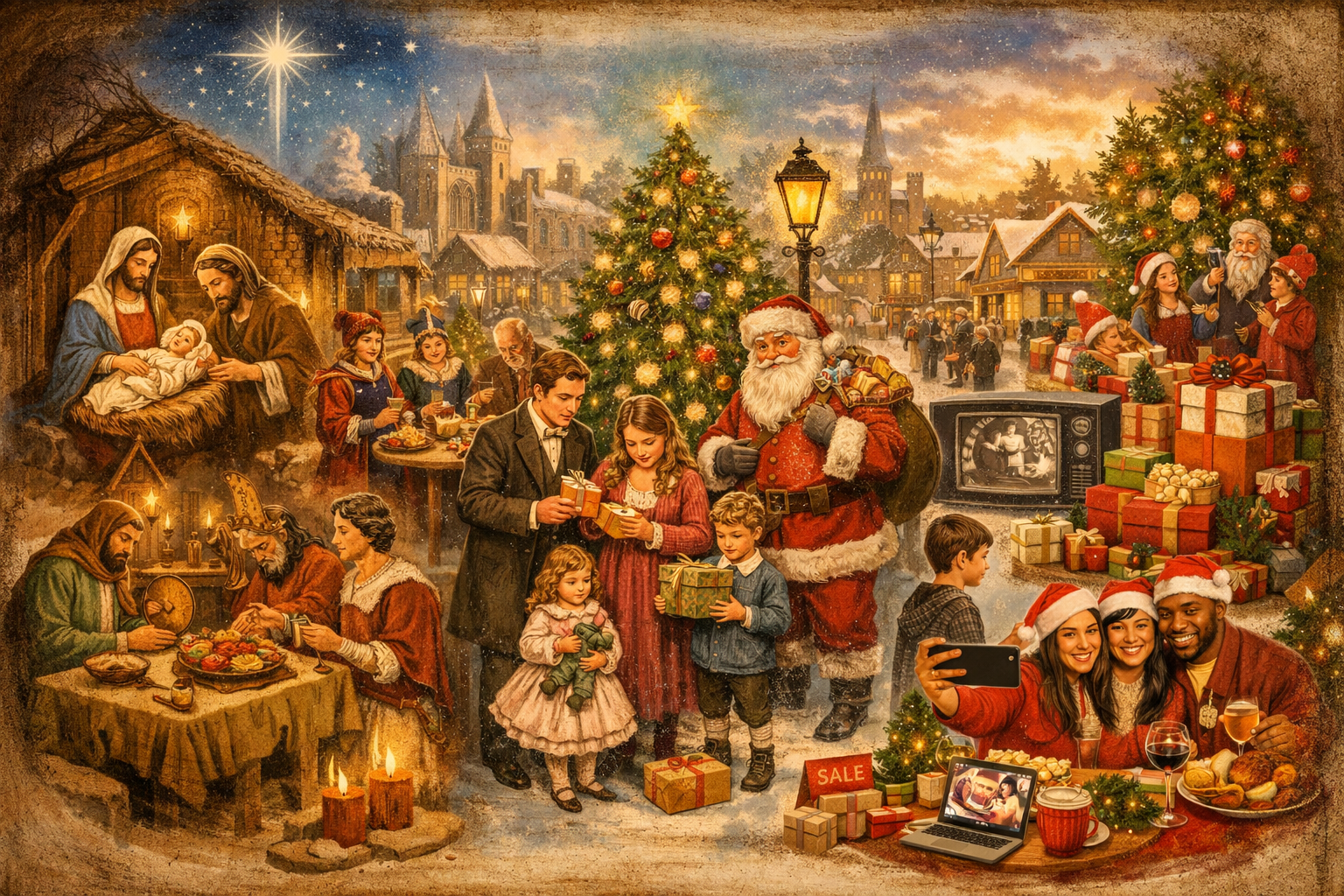
Christmas didn’t “arrive” as the modern holiday we recognize. It evolved in distinct phases:
1) Late antiquity to medieval period: liturgy, feast-days, and public festivity
Once Christmas became established on the church calendar, it grew into a season (“Christmastide”) with liturgical structure. In medieval Europe, Christmas could also be loud, rowdy, and public—more like a festival season than a single quiet day. Modern summaries of Christmas history often highlight that the tone of Christmas has shifted dramatically across eras, including periods of restriction and backlash (for example among Puritans). (AP News)
2) Early modern to 19th century: domestic “family Christmas” takes shape
Many features people now assume are “timeless” are relatively modern:
- The Christmas tree spread widely in the English-speaking world in the 1800s, influenced by German traditions and famously boosted by royal example and media depiction in Britain. (History Today)
- Christmas cards took off as postal systems expanded; the first commercial Christmas card is widely associated with Henry Cole (1843) and is documented by institutions like the Victoria and Albert Museum. (Victoria and Albert Museum)
- Literature helped reshape the holiday into a moral vision of warmth, charity, childhood, and home—an influence commonly linked (among others) to Victorian-era culture (often discussed in broad historical overviews). (AP News)
3) 20th–21st century: mass media, consumer culture, and global “Christmas season”
Department stores, advertising, radio/TV, and later the internet amplified Christmas into a major commercial season. The “holiday shopping” structure (decorated storefronts, seasonal promotions, gift catalogs) became part of modern Christmas in many countries—sometimes embraced, sometimes criticized.
At the same time, the season also became a major force for philanthropy and social support (food drives, charity giving, community volunteering). In many places, the cultural Christmas (music, lights, shared meals) became inclusive enough that non-Christians participate as neighbors and friends.
4) The newest layer: digital Christmas
In the last couple of decades, celebrations have been reshaped again by:
- online shopping and digital gifting
- long-distance family video calls
- social media traditions (photos, reels, community drives)
- globally shared pop culture (songs, movies, memes)
So Christmas today is a blend of: ancient liturgy, medieval festival energy, Victorian domestic traditions, and modern global media and commerce—with each society choosing its own balance.
In short: why Christmas became so universal
Christmas traveled well because it offers multiple “entry points”:
- a sacred story (for believers)
- seasonal symbolism (light, hope, generosity)
- family rituals (food, music, reunion)
- adaptable local customs (trees, stars, lanterns, gift-bringers, special foods)
- a calendar moment many societies already marked as significant in winter
References:
- Encyclopaedia Britannica – Christmas (history, meaning, date): Christmas (Encyclopedia Britannica)
- Encyclopaedia Britannica – Why Christmas is in December: Why Is Christmas in December? (Encyclopedia Britannica)
- Encyclopaedia Britannica – How December 25 became Christmas (Rome 336 CE): How did December 25 become Christmas? (Encyclopedia Britannica)
- National Geographic – Roman winter context, Saturnalia/Sol Invictus discussion: Was Christmas moved to eclipse Rome’s Saturnalia festival? (National Geographic)
- Encyclopaedia Britannica – Santa Claus background: Santa Claus (Encyclopedia Britannica)
- History Today – Earliest recorded Roman celebration on Dec 25 (336 CE): The First Christmas Celebration (History Today)
- Victoria and Albert Museum – First Christmas card (1843): The first Christmas card (Victoria and Albert Museum)
- Wikipedia (overview support; use alongside primary references) – Christmas tree history: Christmas tree (Wikipedia)
- Associated Press – How Christmas evolved globally (overview): AP explainer (AP News)
- People / Garden & Gun – KFC Christmas in Japan (1974 campaign): People explainer, Garden & Gun explainer (People.com)
- Wikipedia (overview support) – Simbang Gabi: Simbang Gabi (Wikipedia)
- Wikipedia + WhyChristmas (overview support) – Ethiopian Christmas (Genna/Ganna, Jan 7): Ethiopian Christmas, Christmas in Ethiopia (Wikipedia)