

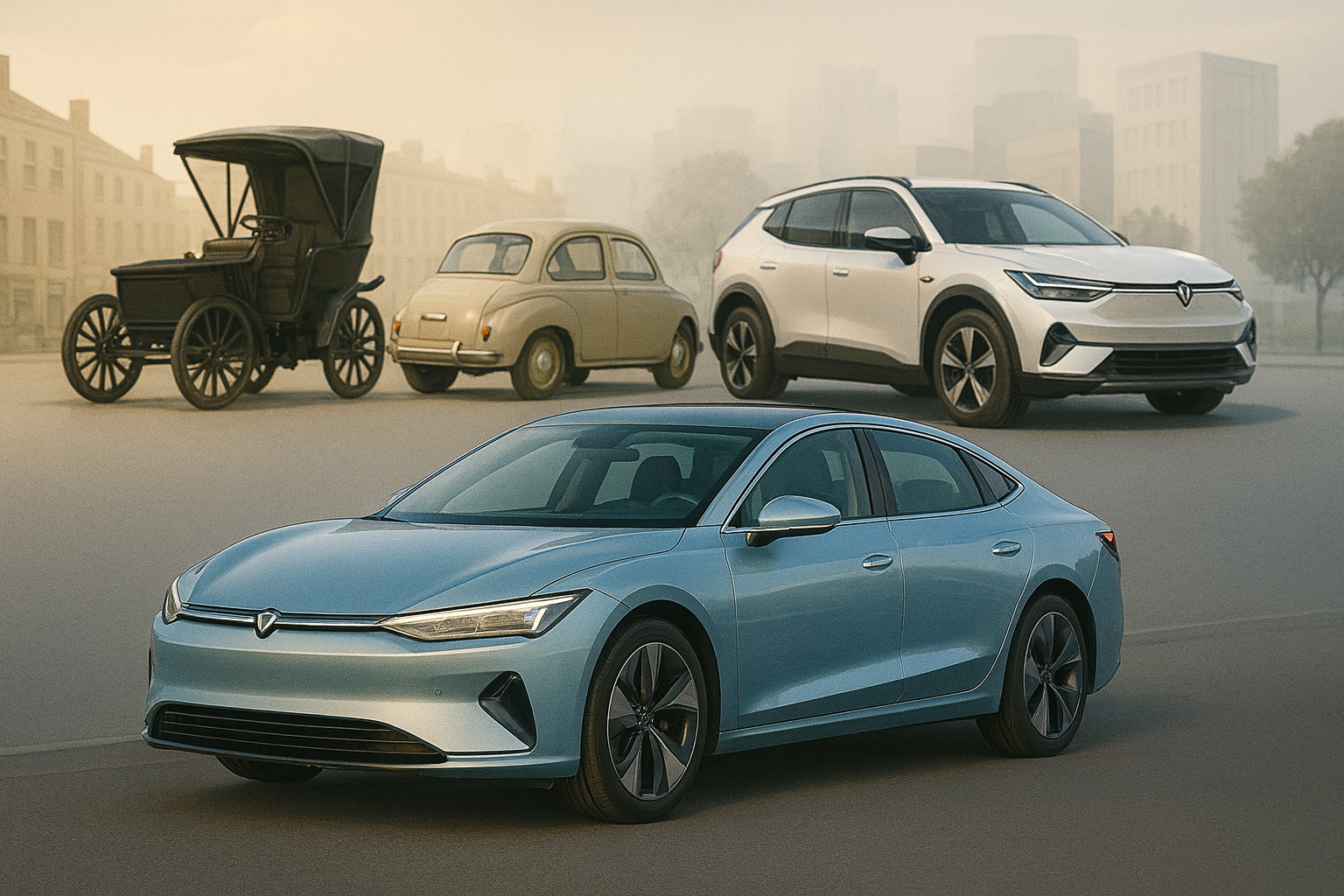
Electric vehicles (EVs) have surged to the forefront of transport debates. Advocates say they’re the future of clean mobility. Skeptics point to battery-production emissions, electricity sourcing, and supply-chain constraints. The question isn’t simply “good or bad”, but: under what conditions are they beneficial, what trade-offs exist, and how should policy and consumers navigate them?

Origins & Evolution of EVs
The concept of electric propulsion in road vehicles is older than many assume. Early pioneers in the 19th century developed crude electric carriages. (Wikipedia)
For example: a chemist in Iowa, William Morrison, built a six‐passenger electrified wagon around 1890. (The Department of Energy’s Energy.gov)
By 1900 electric cars accounted for around one-third of U.S. vehicles in some markets. (rizontruck.com)
However, EVs declined rapidly once internal‐combustion-engine (ICE) vehicles, improved infrastructure and cheap oil matured. (HISTORY)
Modern resurgence—from the 1990s onward—was driven by battery advances (lithium-ion), environmental regulation, and oil security concerns. (GreenCars)
Main Components of an Electric Vehicle & Manufacturing
a) Key components
- Battery pack (typically lithium-ion): the central energy storage.
- Electric motor(s): convert electrical energy into mechanical motion.
- Power electronics / inverter / controller: manage flow between battery, motor and grid/charger.
- On-board charger / battery management system (BMS): regulate charging, safety, thermal management.
- Thermal management system: keep battery/motor/electronics within temperature bounds.
- Lightweight chassis and body: often enhanced so that increased battery weight doesn’t degrade performance badly.
b) Manufacturing & supply-chain considerations
- Battery production is energy-intensive: mining of lithium, cobalt, nickel, graphite, etc.; cell manufacturing; pack assembly; thermal & safety infrastructure. For example, battery manufacturing contributes significantly to the lifecycle climate impact of EVs. (PMC)
- The source of electricity for manufacturing also matters: production facilities powered by coal vs renewables differ drastically in carbon intensity. (ScienceDirect)
- Beyond batteries: electric motors require rare earths or specialty magnets in some cases; supply-chain constraints of critical minerals can influence environmental and geopolitical outcomes. (arXiv)
- Assembly of EVs: many manufacturers adapt ICE vehicle plants but may require new workflows for battery integration, high-voltage safety, and different drivetrain architecture.
How EVs Differ from Conventional ICE Vehicles
a) Drivetrain & operation
- ICE vehicles: fuel (gasoline/diesel) combusted in engine; mechanical transmission; exhaust emissions.
- EVs: electricity stored in battery; electric motor(s) drive wheels (often direct drive or single speed); no tailpipe emissions during driving.
- Driving characteristics: EVs often deliver instant torque, smoother acceleration, quieter ride, less vibration.
- Regenerative braking: EVs recover kinetic energy when decelerating, improving efficiency.
b) Maintenance & components
- Fewer moving parts in drivetrain → potentially lower maintenance (no oil changes, fewer filters, simpler transmission).
- Battery degradation: over time battery capacity declines; lifetime warranties vary.
- Infrastructure: ICE vehicles use fueling stations; EVs depend on charging infrastructure (home, workplace, public) and the underlying electricity grid.
c) Fuel cost & energy efficiency
- EVs are typically far more energy efficient: e.g., electric drive components have high efficiencies and many EVs today achieve high MPGe (miles per gallon equivalent) or low kWh/100 miles. (Alternative Fuels Data Center)
- Fuel cost per mile for EVs can be lower, depending on electricity cost, charging time/availability, and vehicle usage.
Economic & Consumer Impacts
a) For customers
Pros:
- Lower “fuel” (electricity) cost per mile (in many regions).
- Quieter, smoother driving experience; high performance from instant torque.
- Incentives ⇒ many governments offer purchase rebates, tax credits, cheaper registration, preferential parking/lanes. (Alternative Fuels Data Center)
- Potential for home charging convenience (especially overnight at home).
Cons: - Higher upfront purchase cost (though the gap is closing).
- Range anxiety: concern about running out of charge; charging infrastructure may be insufficient in some areas.
- Charging time vs fueling time: even fast-charging takes longer than quick fill-up of gasoline.
- Battery degradation / replacement cost risk: batteries do degrade; warranties cover but long-term performance uncertain in some climates.
- Resale value uncertainty: evolving technology may affect resale value.
- Infrastructure dependency: need for charging access (especially for renters or those without dedicated parking).
b) For economy & industry
- Shift from traditional ICE manufacturing to EV manufacturing: implications for jobs, supply-chain, services.
- New industries: battery manufacturing, charging infrastructure, software services, vehicle-to-grid (V2G) services.
- Raw-material markets: lithium, cobalt, nickel demand surges; this can create price volatility and supply-chain risk.
- Used ICE fleet may depreciate faster; secondary markets may change.
- Charging infrastructure build-out requires investment in grid capacity, local generation, utility business models.
Real Environmental Impact — Not Just “Eco-Friendly”
a) Tailpipe vs life-cycle emissions
EVs have zero tailpipe emissions when driving (pure battery electric). (Alternative Fuels Data Center)
However, the full environmental impact must cover manufacturing, electricity generation, battery end-of-life / recycling, and supply-chain mining.
Manufacturing (especially battery production) can produce higher initial emissions than manufacturing a comparable ICE vehicle. (Environmental Protection Agency)
A 2022 study found that production accounted for ~43% of the BEV (battery-electric vehicle) climate impact in a reference scenario; use-stage contributed ~45%. (PMC)
b) Electricity source matters
If EVs are charged in regions where electricity is produced from coal or other high-emission sources, the advantage over ICE vehicles is reduced. (Alternative Fuels Data Center)
Conversely, as grids decarbonise (more renewables), the environmental benefit strengthens. The same study noted that future changes in electricity production could reduce climate impact by ~9% in the use-stage alone. (PMC)
c) Materials, mining & end-of-life
Battery manufacture often involves mining of lithium, cobalt, nickel; these processes can be water-intensive, polluting, and involve ethical/social concerns. (Earth.org)
Recycling of battery materials remains nascent; encouraging second-life uses and improved recycling improves the environmental footprint. (PMC)
d) Are EVs always better?
Some studies caution: in certain regions with dirty grids and inefficient manufacturing, EVs may not clearly beat efficient ICE vehicles (or hybrids) in terms of life-cycle emissions. (ScienceDirect)
Geopolitical & Industry Influences
- The transition to EVs is reshaping global supply chains: countries rich in lithium, cobalt or rare-earths may gain strategic importance. However concentration of battery manufacturing (e.g., in China) raises concerns about supply-chain dominance. (The Washington Post)
- Raw-material bottlenecks: limited reserves of cobalt, graphite, etc., may constrain EV growth or raise costs. (arXiv)
- National policy and industrial strategy: many governments subsidise EV manufacturing, infrastructure build-out, and set ICE phase-out dates, influencing competitiveness and trade.
- Grid diplomacy: as electricity supply becomes more central to mobility, countries rich in renewable energy, grid tech or battery raw materials can enhance their influence.
- Energy security: for oil‐importing countries, EVs offer a path to reduce dependence on imported petroleum; but they shift dependence to critical minerals and electricity—so risk profiles change rather than vanish.
Evaluation: Pros & Cons from a Consumer / Societal Point of View
Pros:
- Potentially lower lifetime fuel/energy costs.
- Reduced local air-pollution (especially in urban areas).
- Improved performance (acceleration, lower noise).
- Supporting climate-goals if paired with clean electricity.
- Future features: V2G (vehicle-to-grid) services, home energy storage synergy.
Cons:
- Higher upfront cost and uncertainty about long-term battery health.
- Charging infrastructure still uneven: home chargers, public network variability.
- Charging time and range still concerns in some markets.
- Environmental trade-offs: manufacturing emissions, raw-material impact, grid source.
- Infrastructure for supply/maintenance (new mechanics, battery servicing) may lag in some regions.
- Regional variation: the benefits of EVs are highly dependent on electricity mix, local grid, vehicle usage profile.
Conclusion & Future Mobility Solutions
So, are EVs good or bad? The answer depends on context. Good when:
- Powered by low-carbon electricity,
- Used in a way that exploits their efficiency (urban/hybrid use),
- Supported by proper infrastructure, recycling, informed policy.
Less good when:
- Charged from coal-heavy grids,
- Manufactured under highly polluting conditions,
- Used in contexts where ICE or hybrid alternatives may perform better lifecycle-wise.
Future mobility directions:
- Hybrid and plug-in hybrid vehicles (PHEVs) remain transitional in many markets.
- Fuel-cell electric vehicles (FCEVs) (hydrogen) may serve long-haul or heavy sectors.
- Shared mobility + micro-mobility (e-bikes, scooters, public transport) reduce per-capita vehicle use.
- Smart charging / V2G: EVs as part of a flexible grid, storing renewable energy, smoothing demand. (arXiv)
- Battery innovation: solid-state, sodium-ion, reduced cobalt/rare-earth designs will lower cost and environmental impact.
- Circular economy & recycling: second-life batteries, improved material recovery will reduce cradle-to-grave impact.
- Systemic change: combining decarbonised grid, efficient vehicles, better public transport, behavioural shifts—not just swapping ICE for EV.
In short: EVs are a powerful tool in the mobility transition—but not a panacea by themselves. Their true benefit depends on how they are deployed, powered and recycled. For consumers and societies alike, smart policy, infrastructure and holistic systems thinking are critical to making them genuinely “good”.
References
- U.S. Department of Energy, The History of the Electric Car. (The Department of Energy’s Energy.gov)
- U.S. Alternative Fuels Data Center, Electric Vehicle Benefits and Considerations. (Alternative Fuels Data Center)
- U.S. EPA, Electric Vehicle Myths. (Environmental Protection Agency)
- Koroma M. S. et al., “Life cycle assessment of battery electric vehicles”. (PMC)
- Albrechtowicz P. et al., “Electric vehicle impact on the environment …” (2023). (ScienceDirect)
- Earth.org, “The environmental impact of battery production for EVs”. (Earth.org)
- Guzek M., “Electric Vehicles—An Overview of Current Issues—Part 1”. (mdpi.com)
- “How China pulled ahead to become the world leader in electric vehicles”. Washington Post (2025). (The Washington Post)