
Harappa and Mohenjo-daro: Twin Cities of the Indus Civilization
On the plains of the Indus and its tributaries, two Bronze Age cities—Harappa in Punjab and Mohenjo-daro in Sindh—still speak through bricks, drains, seals, and sculpture. This feature stays close to the archaeological evidence, and labels interpretation where the debates begin.
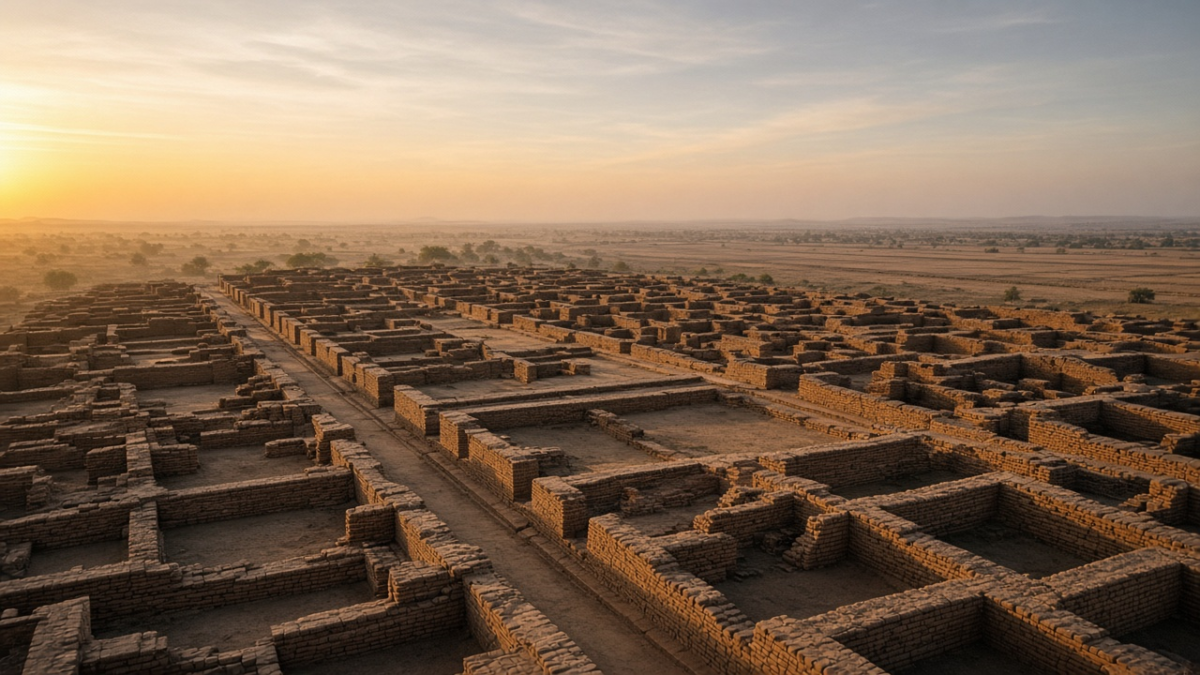
Visit the excavated streets of Mohenjo-daro (also spelled Moenjodaro) or the mounds of Harappa, and the first impression is not of ruined temples or royal tombs. It is of order: baked-brick platforms, wells, bathing places, and lanes that once carried wastewater under cover. These two sites are the best-known urban centres of the Indus Valley Civilization—also called the Indus or Harappan Civilization—one of the Old World’s great Bronze Age societies, geographically larger than Egypt or Mesopotamia at their peaks and spread across much of present-day Pakistan, northwestern India, and parts of Afghanistan.
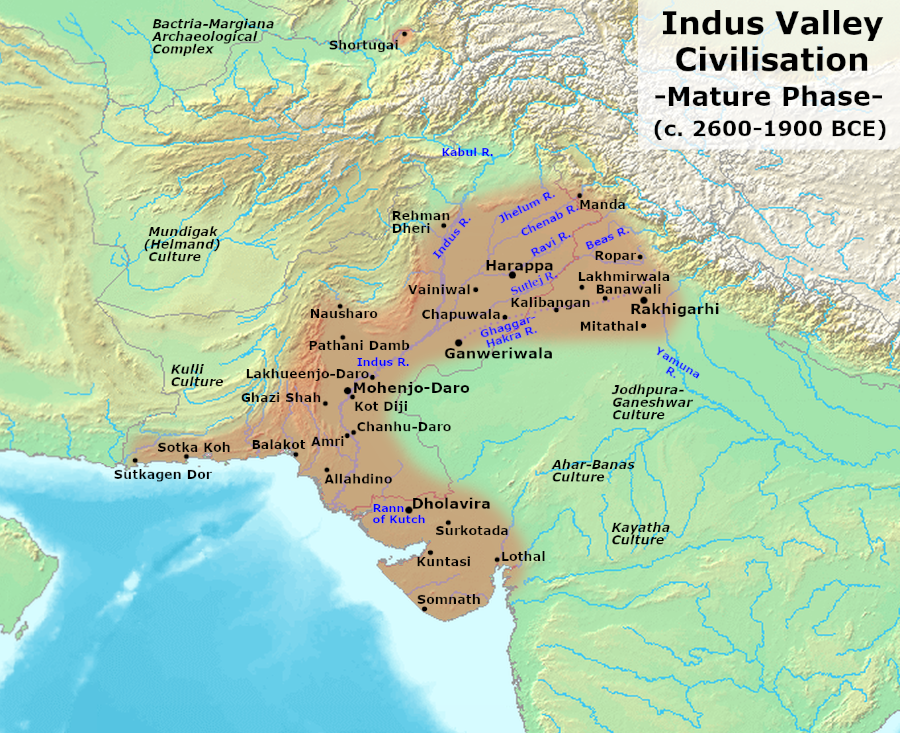
Harappa and Mohenjo-daro were never isolated marvels. They belonged to a wider network that, in the Mature urban phase, included centres such as Rakhigarhi, Dholavira, Lothal, and others along the Indus and the now-seasonal Ghaggar–Hakra system. What the twin cities offer is density of evidence: decades of excavation, UNESCO recognition for Moenjodaro, and a material record strong enough to support careful reconstruction—and honest uncertainty.
Discovery: from railway ballast to world heritage
Harappa entered modern scholarly awareness earlier than Mohenjo-daro. Brick robbers and railway contractors in the nineteenth century carted away Harappan baked bricks as ballast for the Lahore–Multan line, damaging the site before archaeology could protect it. Systematic work by the Archaeological Survey of India in the early twentieth century—associated with figures such as Daya Ram Sahni at Harappa and, in the 1920s, the recognition and excavation of Mohenjo-daro (often linked with R. D. Banerji and the era of Director-General John Marshall)—showed that these were not medieval ruins but the remains of a previously little-known Bronze Age urban culture.
Marshall’s announcements in the 1920s reframed South Asian prehistory. Pottery, seals, and architecture demonstrated a civilization contemporary with Old Kingdom Egypt and Sumerian city-states, yet distinct in its urban grammar. Later generations of excavators refined stratigraphy and radiocarbon chronologies. Long-term projects at Harappa under scholars including Jonathan Mark Kenoyer and colleagues have traced how a settlement grew into a multi-mound city. At Mohenjo-daro, early large-scale clearances revealed the Great Bath, street grids, and residential blocks; later work has stressed conservation as much as new digging, because salinity, rising groundwater, and weathering threaten exposed brick.
In 1980, UNESCO inscribed the Archaeological Ruins at Moenjodaro as a World Heritage Site—the first such listing in South Asia. UNESCO’s brief description places the huge city’s ruins in the Indus valley in the third millennium BCE, notes an acropolis on high embankments, ramparts, and a lower town, and, in its Outstanding Universal Value text, recalls that Moenjodaro flourished (in WHC phrasing) between about 2500 and 1500 BCE, with planned streets, baths, drains, wells, and soak pits. Scholars’ calibrated radiocarbon frameworks usually tighten the Mature urban peak to roughly 2600–1900 BCE; both phrasings are useful if their scopes are kept clear.
Chronology without false precision
Popular timelines sometimes collapse a millennium into a single “Harappan age.” Archaeological consensus prefers phases:
- Early Harappan / Regionalization (c. 3300–2600 BCE, approximate): regional ceramic and settlement traditions across the greater Indus, building toward urban integration. Roots reach back further into Neolithic and Chalcolithic communities (Mehrgarh in Balochistan is a famous earlier sequence, not a “Harappa suburb”).
- Mature Harappan / Integration (c. 2600–1900 BCE): large cities, standardized craft packages, seals and script, long-distance exchange. Kenoyer and others subdivide this long span at Harappa using pottery, seals, and architecture (for example periods often labelled 3A–3C), reminding readers that “Mature” was not a static seven centuries.
- Late Harappan / Transformation (after c. 1900 BCE, continuing regionally toward the mid-second millennium BCE): deurbanization, shifts in settlement, ceramic change—better described as transformation than as a single overnight collapse.
Absolute dates rest on radiocarbon samples in stratified contexts and on cross-comparisons among sites. They remain approximate ranges, not engraved foundation stones. Where UNESCO’s 2500–1500 BCE window and the scholarly 2600–1900 BCE Mature peak differ, the gap is mostly about how “flourish” and “abandonment” are defined—not about inventing incompatible pasts.
Urban form: two cities, shared habits, local histories
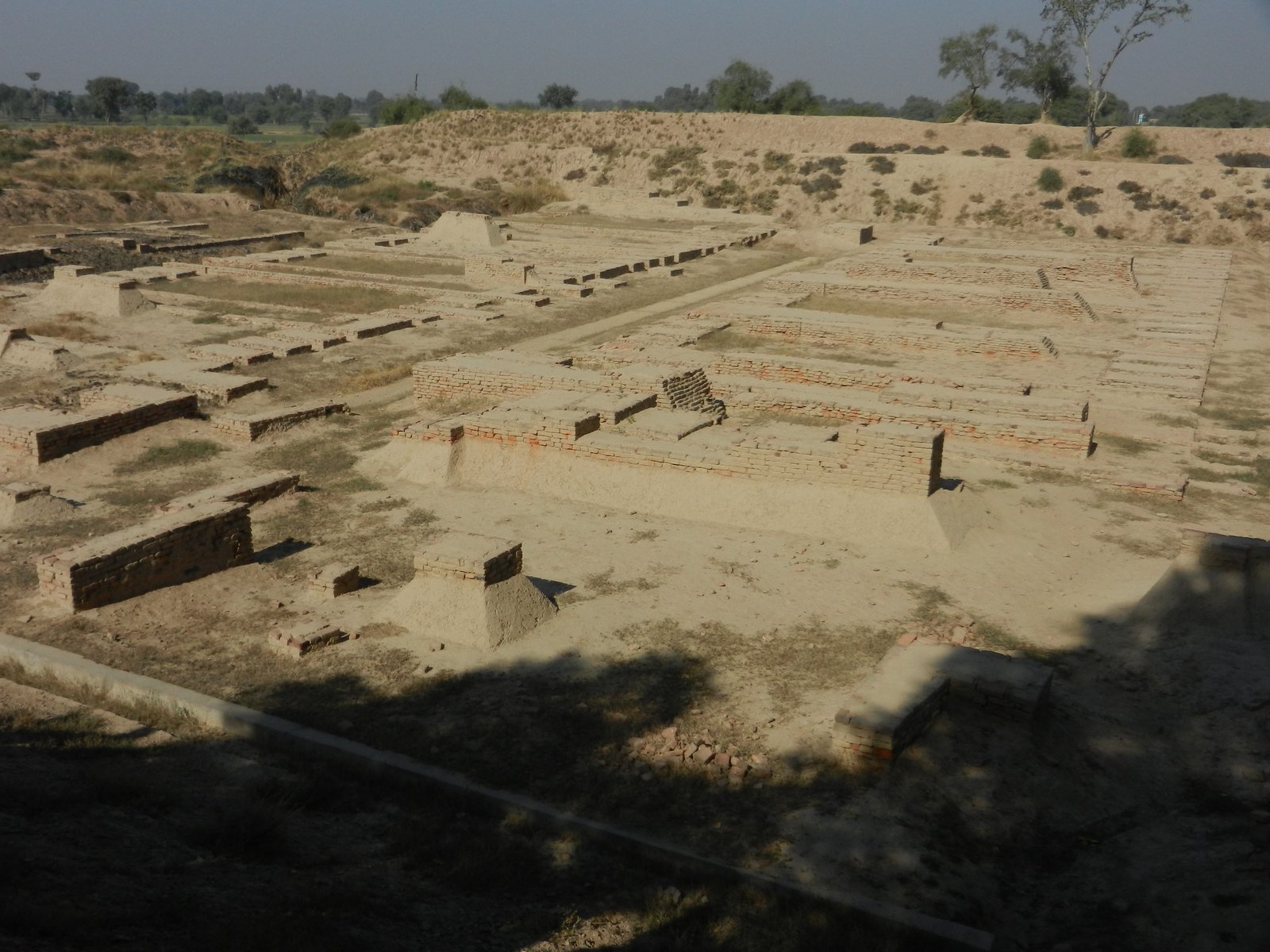
Harappa, near the former course of the Ravi in Punjab, Pakistan (about 24 km west of Sahiwal), grew as a multi-mound city. At its Mature height it may have housed on the order of 20,000–25,000 people across roughly 150 hectares—large for its time, though estimates vary with how mounds and suburbs are counted. Excavation has revealed massive mud-brick walls and gateways, streets wide enough for cart traffic, and house drains. Kenoyer has argued that walls and controlled gateways may have regulated access and commerce as much as they served pure defense—an interpretation grounded in gateway architecture and craft distributions, not in recovered “customs ledgers.”
Mohenjo-daro, in Larkana District, Sindh, on the Indus floodplain, was among the largest Indus settlements. Population estimates often centre near 40,000 (with wider scholarly ranges sometimes cited from roughly 30,000 upward). UNESCO notes burnt-brick structures covering about 240 hectares, of which only about one-third has been excavated since the 1920s. The site divides into a western citadel (or high mound)—later capped by a Buddhist stupa of the early centuries CE—and an eastern lower town of rectilinear streets and dense housing. Right-angled intersections and baked-brick construction dominate the visible plan, though detailed studies caution against imagining a single rigid grid imposed overnight; cities grew in stages of platform building and reinforcement.
Shared traits matter: standardized brick proportions, neighbourhood wells, bathing platforms, and covered drains appear at both cities and many smaller Harappan sites. Differences matter too: Mohenjo-daro’s Great Bath is unmatched at Harappa; Harappa’s long sequence of excavation has clarified growth from earlier levels that high water tables long obscured at Mohenjo-daro. Urbanism across the Indus was multicentric, not a carbon-copy capital and colony system.
Water, wells, and the strongest civic signature
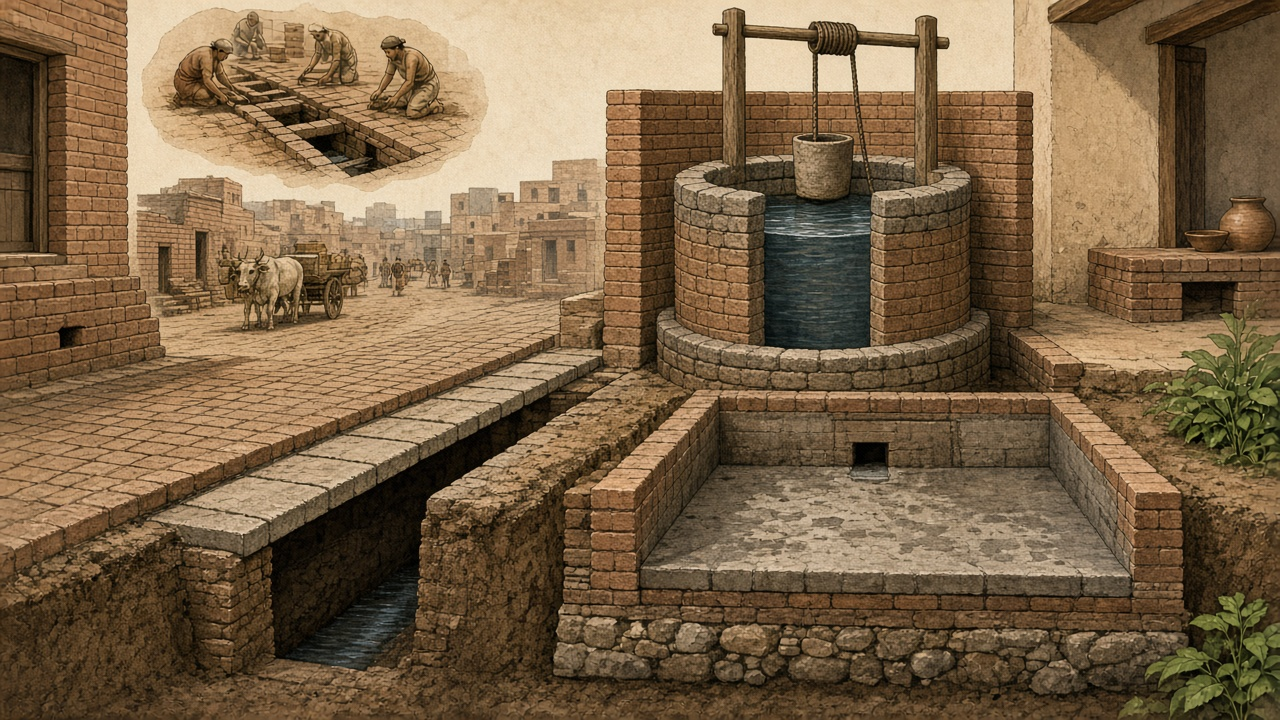
If one class of evidence defines Harappan cities for both specialists and visitors, it is water management. Households drew from brick-lined wells. Bathing platforms and private washing areas connected to drains. Covered street drains carried wastewater toward soak pits or outlets. At Harappa, excavated wells and bathing platforms of Mature occupation (often discussed for horizons around the later third millennium BCE) make the system tangible: this was not an afterthought of elite display but a neighbourhood infrastructure.
The engineering logic is civic. Waterproofing, gradients, and maintenance imply rules, labour, and shared expectations about cleanliness and waste. Comparative ancient cities elsewhere show monumental temples or palaces more conspicuously; Indus sites put sanitation and water access near the centre of the archaeological story. That does not prove egalitarian ideology—it proves investment in urban services visible in brick and bitumen.
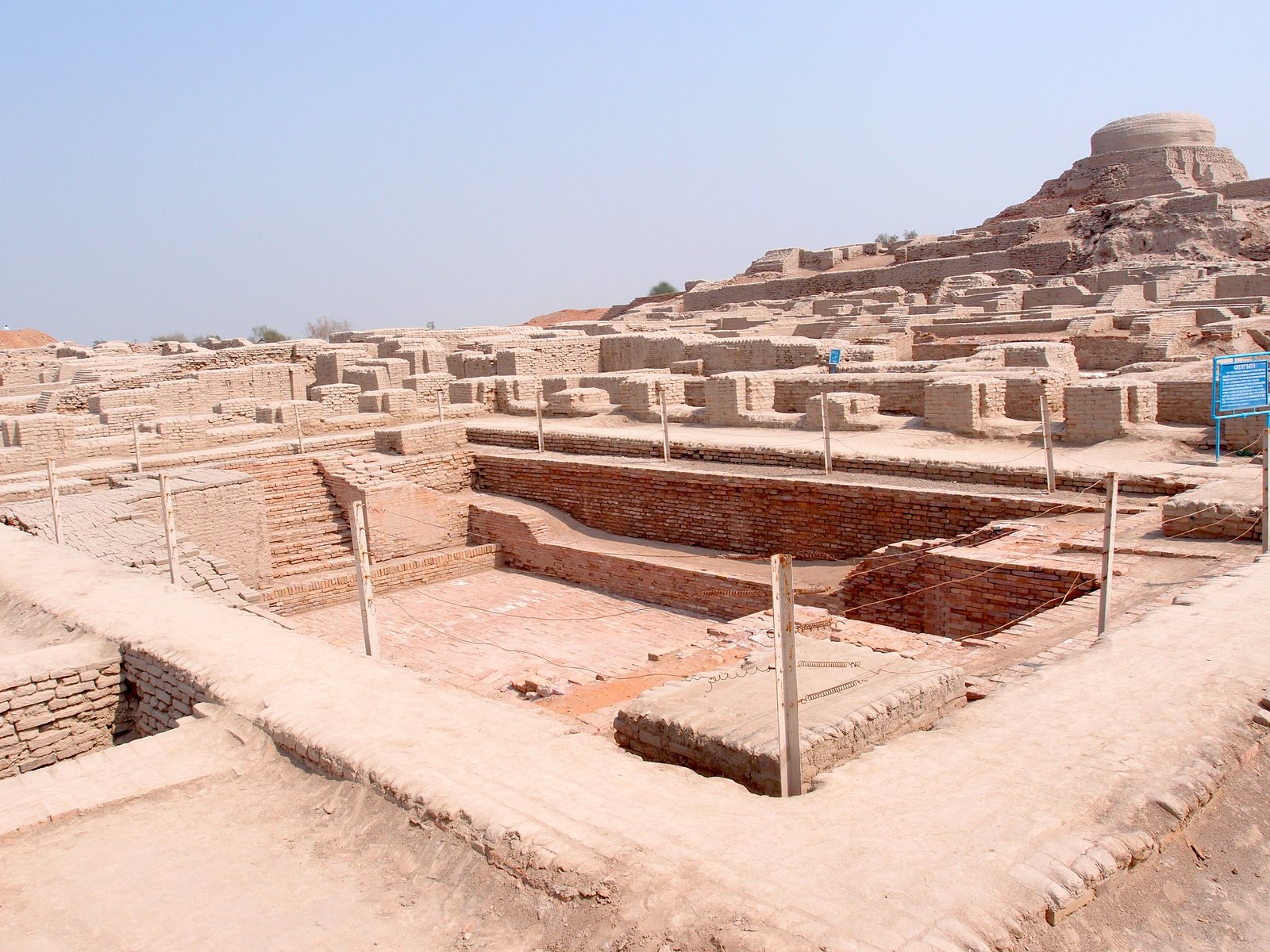
The Great Bath of Mohenjo-daro
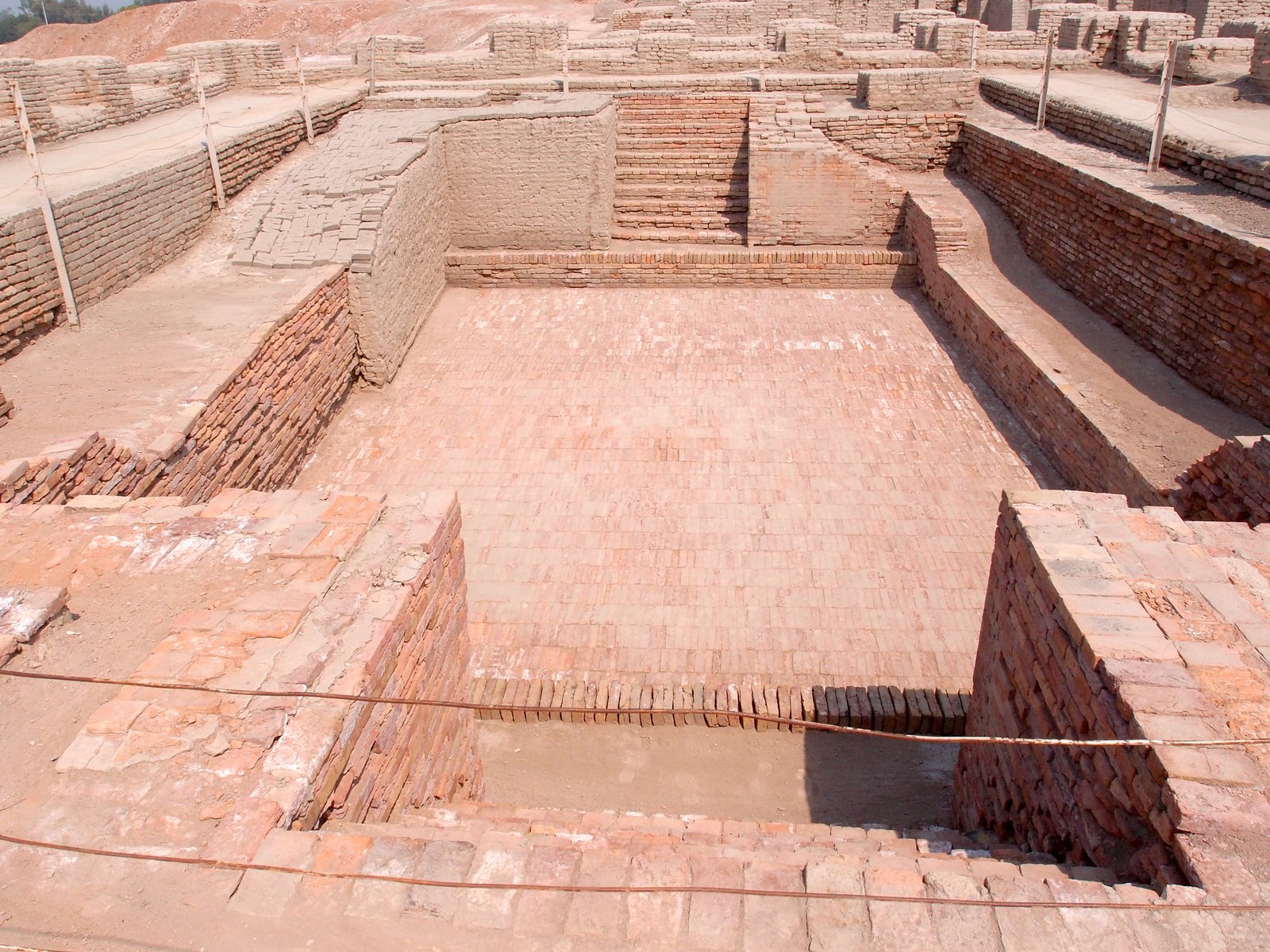
On the citadel mound of Mohenjo-daro sits the structure still called the Great Bath: a sunk tank measuring roughly 12 metres long by 7 metres wide, with a depth of about 2.4 metres. Fine baked brick, a waterproof lining (often described as including bitumen), north and south staircases, a ledge near the base of the stairs, and a drain outlet at one corner form the material facts. It was built in the third millennium BCE, soon after the raising of the citadel mound on which it stands.
Interpretation is more open. Many scholars, including Kenoyer, have suggested special or ritual bathing—water used for purification in a public or ceremonial setting—because of the tank’s careful waterproofing, central citadel location, and the comparative rarity of such a large dedicated pool. Nearby large buildings have sometimes been labelled, tentatively, with priestly associations (older literature’s “College of Priests”), but those labels are interpretive, not self-announcing inscriptions. Secular public bathing remains possible. The evidence securely shows a major water architecture project; it does not yet dictate a single theology.
Craft, trade, and the quiet power of weights
Harappan craft specialization is abundant in the debris: carnelian beads (often heat-treated and etched), shell working, faience, copper and bronze tools and ornaments, steatite seal carving, and standardized ceramics. Workshop areas and unfinished pieces at cities and smaller sites show production beyond household need.
Cubical chert weights, carefully finished and following a binary/decimal-like ratio system in many assemblages, are among the clearest signs of regulated exchange. Brick ratios and measuring rods or comparable length standards reinforce the picture of shared technical norms across long distances. Such standardization does not require a single emperor; it does require networks of training, trust, and enforcement—merchant groups, civic authorities, or both.
Long-distance contacts are attested carefully, not romantically. Indus-style seals and etched carnelian beads appear in Mesopotamian contexts; Mesopotamian texts refer to a land often identified with the Indus region (Meluhha in many scholarly readings). The scale and political meaning of that trade remain debated. What is not debated is that Harappan makers participated in Bronze Age interaction spheres reaching the Gulf and beyond, while their agricultural base—diversified crops, cattle and other animals known from zooarchaeology, and early cotton among fibre plants—supported urban populations at home.


Seals and an undeciphered script
Steatite stamp seals—often showing a humped bull, elephant, rhino, or the famous “unicorn” motif, plus short lines of signs—are the Indus world’s most iconic portable artefacts. Sealings on clay show they authenticated containers, doors, or packages: tools of economic and administrative control even while the signs remain unread.
The Indus script (Harappan script) comprises hundreds of distinct signs across thousands of short inscriptions. No bilingual “Rosetta” text is known. Most strings are brief, which fuels debate over whether the system encoded full language, a more limited notation, or something in between. Despite many proposed decipherments, scholarly consensus holds that the script remains undeciphered. Linguistic affiliations (including Dravidian hypotheses advanced by some researchers) stay contested. Responsible popular writing should treat any “translation” of a seal as unverified unless it survives specialist scrutiny.
Absence of readable royal inscriptions is itself evidence of a kind: political messages, if they existed in writing, were not carved on palace walls in the Egyptian or Mesopotamian manner that modern museums highlight. Power may have been exercised through seals, weights, and urban regulation rather than through boastful monumental text—or writing may have served purposes we still misread. Both possibilities remain on the table.
Society without obvious palaces
Egypt has pyramids and named kings; Mesopotamia has palaces and temple estates. Harappa and Mohenjo-daro show large public platforms, gateways, the Great Bath, possible assembly or warehouse structures (including buildings long nicknamed “granaries,” whose storage function is sometimes reassessed), and houses that vary in size—but no clear royal tombs, throne rooms, or temples in the classic Near Eastern sense have been securely identified.
That absence is evidence, not a blank. Scholars such as Kenoyer have discussed influential elites—likely combinations of merchants, landowners, and ritual specialists—and forms of corporate or collective governance rather than a single hereditary monarchy ruling the entire Indus. Others explore ranked households visible in house size and ornament. The debate is live: lack of palaces does not automatically mean egalitarianism, and presence of craft inequality does not automatically mean a god-king. What the cities securely show is complex organization capable of large labour projects without the archaeological signature of pharaonic display.
Art that survived the mud-brick city
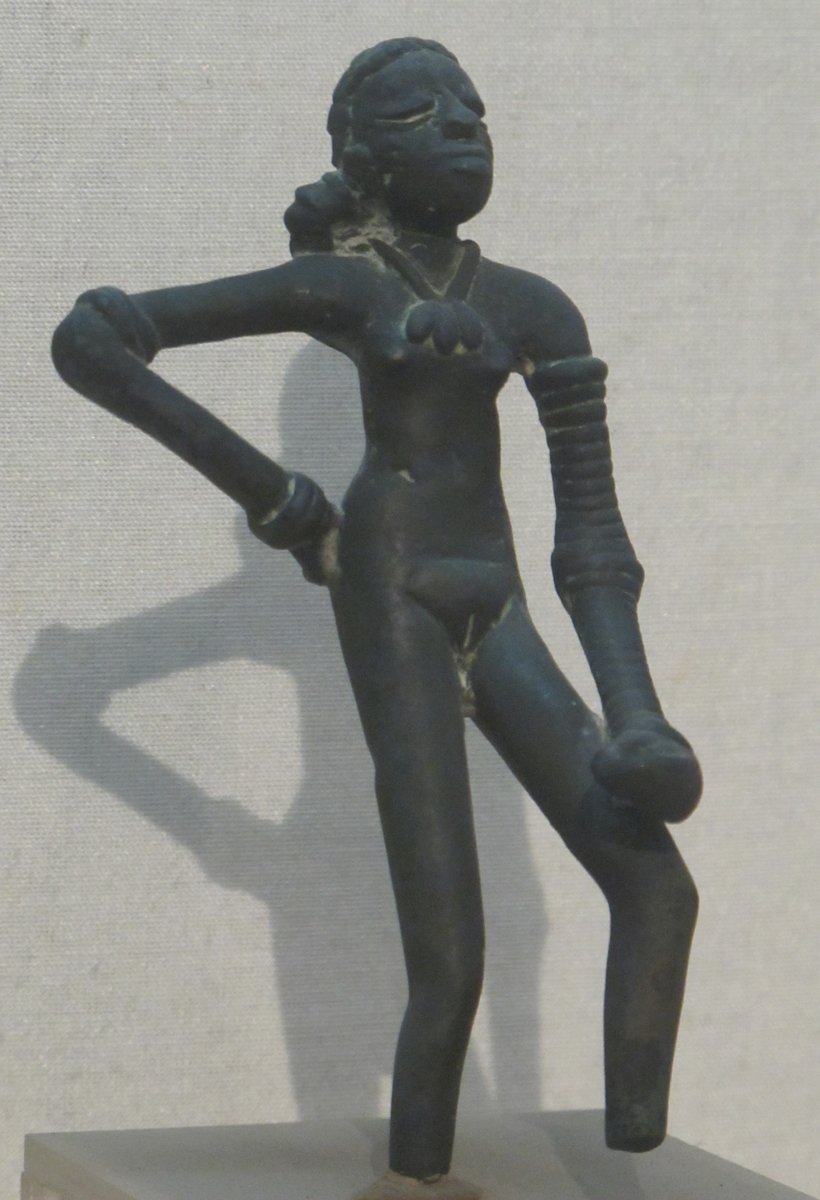
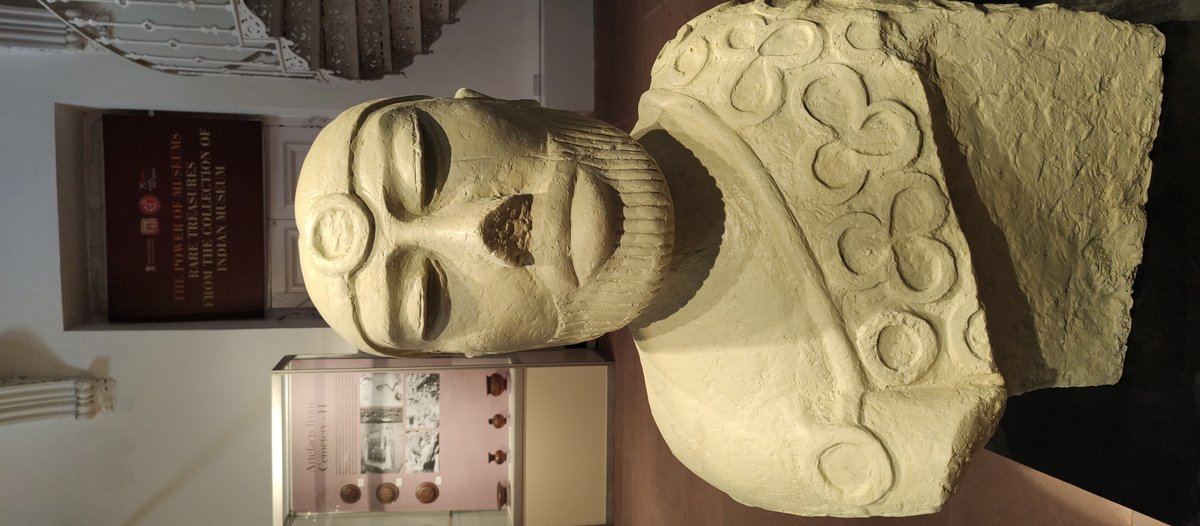
Two finds from Mohenjo-daro have become global ambassadors of Indus art. The small bronze “Dancing Girl”—about 14 cm high, found in 1926 in a residential context—stands in a poised, informal stance that still startles viewers with its confidence. The so-called Priest-King (a modern nickname, not an ancient title) is a steatite bust with a trefoil-patterned robe and a calm, bearded face; museum displays in Pakistan and abroad have made it a symbol of Harappan dignity. Terracotta figurines, painted pottery, and carved seal animals fill out a visual world attentive to bodies, beasts, and ornament.
These objects are not “illustrations of a known pantheon.” Without readable texts, religious meaning is inferred cautiously from contexts, motifs, and later South Asian analogies—useful for hypotheses, dangerous when turned into certainty. Art history here is strongest when it describes technique, findspot, and form, then flags interpretation as such.
Decline—or transformation?
By the early second millennium BCE, the great cities lose their Mature urban coherence. Mohenjo-daro is often described as abandoned by around 1700 BCE in broad outlines; Harappa and many other sites show Late Harappan reorganization rather than a single cinematic destruction layer. Older theories of a sudden “Aryan invasion” that overnight smashed Indus cities are not the settled scholarly consensus. Mobility and cultural change in the second millennium BCE are real research topics, but they do not reduce to a one-cause sack of Mohenjo-daro.
Current models are typically multi-causal: shifts in river courses and monsoon patterns affecting agriculture and riverine trade; economic restructuring as long-distance networks changed; internal social reorganization; and gradual deurbanization as people redistributed into smaller settlements and different regional cultures. Climate and hydrology studies continue to refine the environmental side; archaeology continues to track ceramic and settlement evidence for the human side. “Collapse” is too blunt a word for a transformation that left descendants in later South Asian traditions even as the classic cities emptied.
Why the evidence still matters
Harappa and Mohenjo-daro matter first as primary sources in brick and clay. They expand the map of early urbanism beyond the Nile and Tigris–Euphrates, showing that large, planned cities with sophisticated sanitation could thrive on the Indus plains. They challenge textbook assumptions that early states must look like Egypt or Sumer to count as complex. They keep humility in the humanities: an undeciphered script and an ambiguous political form are not failures of curiosity but reminders that evidence has limits.
They also matter as heritage under stress. Moenjodaro’s UNESCO listing brings international attention to salt damage, groundwater, and the costs of conservation. Harappa’s history of brick-robbing warns how easily a city’s bones become someone else’s railway. Tourism, museums, and school curricula that treat Indus cities as shared human achievement—rather than as props in modern nationalist scripts—honour what excavators actually recovered.
Walk the Great Bath’s empty tank, or stand beside a Harappan well, and the past does not deliver a manifesto. It delivers craft standards, drain gradients, seal impressions, and a few unforgettable sculptures. That is enough. In an age hungry for definitive origin stories, Harappa and Mohenjo-daro offer something rarer: a civilization documented carefully enough to be admired—and still unfinished enough to keep the questions honest.
Sources and further reading
- UNESCO World Heritage Centre — Archaeological Ruins at Moenjodaro (inscription 1980; OUV, criteria ii & iii).
- Kenoyer, Jonathan Mark. Ancient Cities of the Indus Valley Civilization. Karachi: Oxford University Press, 1998; and related papers on Indus urbanism (e.g. Sackler/NAS colloquium drafts hosted via harappa.com).
- Possehl, Gregory L. The Indus Civilization: A Contemporary Perspective. Walnut Creek: AltaMira, 2002.
- Wright, Rita P. The Ancient Indus: Urbanism, Economy, and Society. Cambridge University Press, 2010.
- McIntosh, Jane. The Ancient Indus Valley: New Perspectives. ABC-CLIO, 2008.
- Singh, Upinder. A History of Ancient and Early Medieval India. Pearson, 2008 (Harappan chapters).
- Wikipedia orientation (verify contested claims against scholarship): Indus Valley Civilisation; Mohenjo-daro; Harappa; Great Bath; Indus script.
- Arxiv overview useful for bricks/urbanism bibliography: Bricks and urbanism in the Indus Civilization (2013 preprint).
Image credits
- Featured image & drainage diagram & seal illustration: created for OpenAPen (AI-assisted).
- Mohenjo-daro ruins & Great Bath: Saqib Qayyum / Wikimedia Commons (CC BY-SA 3.0).
- Harappa Mound F: Muhammad Bin Naveed / Wikimedia Commons (CC BY-SA 3.0).
- Unicorn seal: Royroydeb / Wikimedia Commons (CC BY-SA 4.0).
- Dancing Girl: Jen / Ismoon / Wikimedia Commons (CC BY-SA 3.0).
- Priest-King: Ganesh Mohan T / Wikimedia Commons (CC BY-SA 4.0).
- Mature-phase map: Avantiputra7 / Wikimedia Commons (CC BY-SA 3.0).